
Hydraulics & Pneumatics Inspection
Manufacturers of mission-critical hydraulic and pneumatic parts and assemblies used in aviation, automotive and machine automation can inspect for burrs, defects, surface finish irregularities, and more, even inside deep or narrow bores. Hawkeye Precision Borescopes allow fast, reliable visual inspection inside complex machined parts and through very small openings that could never be seen with the naked eye.

Hydraulic sleeve EDM as seen with a Hawkeye Pro Slim 12”

Diesel injector body taken with a Hawkeye Pro Hardy 7”
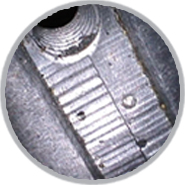
Hydraulic valve body viewed with a Hawkeye Pro Slim Rigid Video 7”
Featured Video
Gradient Lens Corporation manufactures over 80 models of Hawkeye® rigid, flexible, and video borescopes, and a complete system of interchangeable borescope accessories. The Featured Products below are just three examples that hydraulics & pneumatics parts manufacturers find particularly valuable.
Featured Story
Tactair Fluid Controls, Inc.

Special to Hydraulics & Pneumatics Seeing Is Believing: Looking Inside Saves Time, Money Liverpool, N.Y.-based Tactair Fluid Controls, Inc., had been looking for a better way to inspect the intricate internal features of its products. An ISO 9001-2000/AS9100 certified designer and manufacturer of hydraulic and pneumatic controls for the aerospace industry, Tactair specializes in systems for wheel-brake control, landing-gear control, nose-wheel steering control, flight control and engine/nacelle control. Its products are found on fixed and rotary wing business, commuter, transport and military aircraft and include valves, actuators, dampers and manifolds. In these kinds of applications, packaging, weight and contamination resistance tend to be critical. The maze-like flow-path geometries, very fine surface finishes and precision metering edges that can result are common. Such internal features defy easy inspection. Over the years, Tactair had acquired a variety of equipment for visual inspection. It all was underused, according to Tactair manager Bob Buttner, because image quality was poor. Tactair had looked into borescopes, but had not found a moderately priced scope capable of delivering the sharp, clear images the company required. Thus, Tactair resorted to two main ways of inspecting internal features such as deep bores, ID grooves, seat edges, chamfers and metering…